Given strings s1, s2, and s3, find whether s3 is formed by an interleaving of s1 and s2.
An interleaving of two strings s and t is a configuration where s and t are divided into n and m substrings respectively, such that:
s = s1 + s2 + ... + snt = t1 + t2 + ... + tm|n - m| <= 1- The interleaving is
s1 + t1 + s2 + t2 + s3 + t3 + ...ort1 + s1 + t2 + s2 + t3 + s3 + ...
Note: a + b is the concatenation of strings a and b.
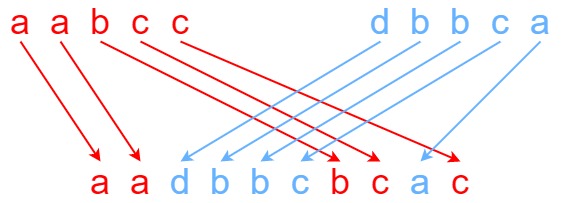
Input: s1 = "aabcc", s2 = "dbbca", s3 = "aadbbcbcac"
Output: true
Explanation: One way to obtain s3 is:
Split s1 into s1 = "aa" + "bc" + "c", and s2 into s2 = "dbbc" + "a".
Interleaving the two splits, we get "aa" + "dbbc" + "bc" + "a" + "c" = "aadbbcbcac".
Since s3 can be obtained by interleaving s1 and s2, we return true.
Input: s1 = "aabcc", s2 = "dbbca", s3 = "aadbbbaccc"
Output: false
Explanation: Notice how it is impossible to interleave s2 with any other string to obtain s3.
Input: s1 = "", s2 = "", s3 = ""
Output: true
0 <= s1.length, s2.length <= 1000 <= s3.length <= 200s1,s2, ands3consist of lowercase English letters.
Follow up: Could you solve it using only O(s2.length) additional memory space?
impl Solution {
    pub fn is_interleave(s1: String, s2: String, s3: String) -> bool {
        if s1.len() + s2.len() != s3.len() {
            return false;
        }

        let s1 = s1.as_bytes();
        let s2 = s2.as_bytes();
        let s3 = s3.as_bytes();
        let mut dp = vec![false; s2.len() + 1];

        for i in 0..=s1.len() {
            let mut tmp = vec![false; s2.len() + 1];
            tmp[0] = i == 0;

            for j in 0..=s2.len() {
                tmp[j] |= i > 0 && s1[i - 1] == s3[i + j - 1] && dp[j];
                tmp[j] |= j > 0 && s2[j - 1] == s3[i + j - 1] && tmp[j - 1];
            }

            dp = tmp;
        }

        dp[s2.len()]
    }
}